


The Understudy ****

“You’re not really an actor without an audience.” It is a brutally dismissive, stark assessment relayed to Eva Seymour in The Understudy — and one that neatly captures the precarious position at the heart of her show.
An understudy is an actor who must be prepared to go on stage at short notice if something happens to a member of the main cast. While it is, of course, paid acting work, the role can prove deeply frustrating: you are constantly preparing to perform, yet rarely given the opportunity to do so.
Seymour provides a glimpse into her life as one such understudy, drawing on her own personal experiences during Covid-19. She is covering eight different roles in a play, so surely an extended run might result in an opportunity to tread the boards?
While not contracted to appear at the theatre each night, she goes in anyway. This is the perhaps a telling indication about the latent anxiety that can beset an actor. She is friendly, helpful and respects boundaries, but remains invisible and is afforded second-class status.
Her commitment to the profession begins to take its toll in her domestic life. Tensions are building with her boyfriend, as she struggles to explain and justify her choices.
Yet there is something else amiss. She is experiencing time disjuncts and memory blackouts. Has she developed a self-destructive personality? Is this an example of ‘understudy madness’? Is she having a breakdown? Or have we now strayed into Black Mirror territory with a doppelgänger on the loose?
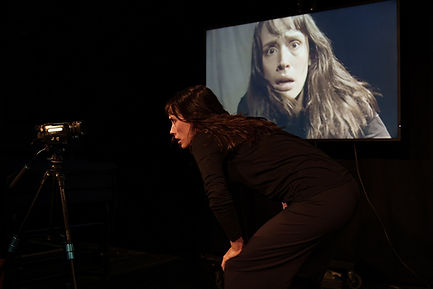
Seymour has constructed an excellent show. The writing unfolds slowly, gradually revealing an intriguing exploration of the pressures faced by actors and the ways in which those pressures can bleed into mental health. The staging is inventive, too. The use of a camera to project Seymour onto a screen initially resembles a self-tape audition, before gradually taking on a more unsettling function, suggesting delays and disruptions in time. Olivia Charalambous’ direction is assured and tightly controlled.
Yet the production ultimately rests on Seymour’s outstanding comic abilities. Her character work is memorable, her timing is sharp, and she maintains a strong connection with the audience throughout. The dance scene is a particular riotous highlight.
Relentless optimism, obsessive behaviour, deep-rooted frustration, the absence of meritocracy, and the indifference shown by some industry professionals all come under Seymour’s scrutiny. It is a sharp, funny and increasingly unsettling examination of what it means to devote yourself to a profession that can so readily make you feel invisible. Many creatives will relate.
Assembly George Square Box, until 30th August.


Comments